Physics engineer · experimental systems

Shivank
Nigam

Physics engineer building robotics systems, quantum software, scientific ML, and hardware-aware control.

I build projects that connect models, measurements, simulation, and reproducible experiments under real operational constraints.

Shivank Nigam
Physics · systems · experiments
Roboticsmemory · policy · control
Quantumsensing · error correction
Scientific MLmodels · baselines · tests
Systemsruntime · cloud · hardware
§01 / Robotics

Robotics and Embodied Systems

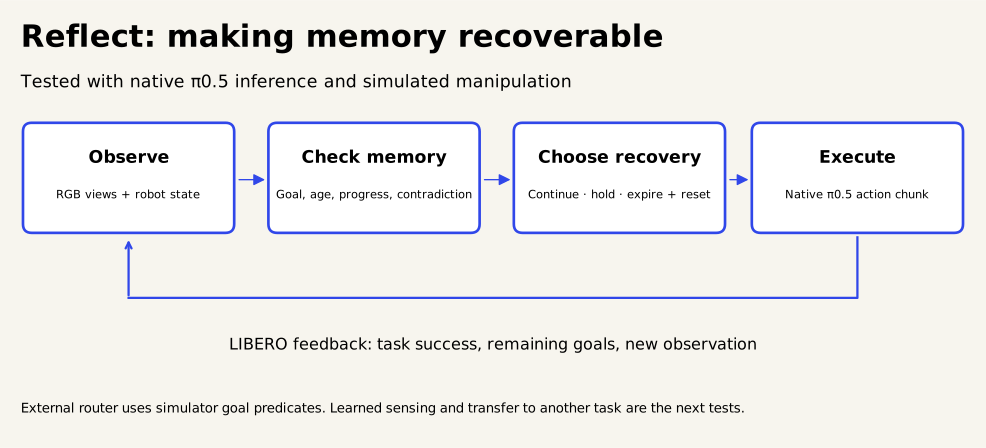
Experiments on where planning, memory, learned policies, execution, recovery, and fast control should meet—and how to test those boundaries before trusting them on hardware.

Flagship research program

Reflect Lite Research

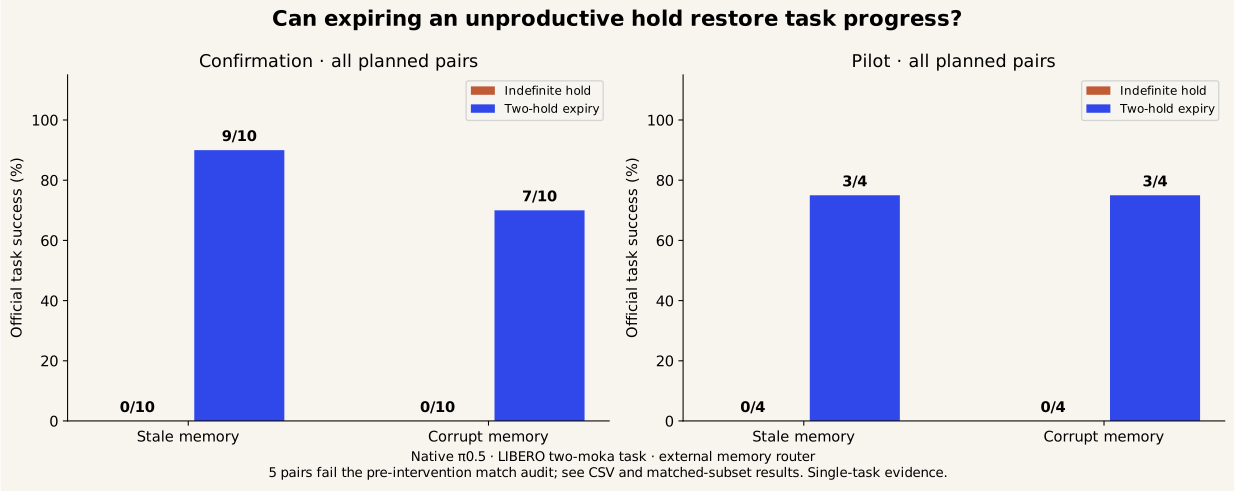
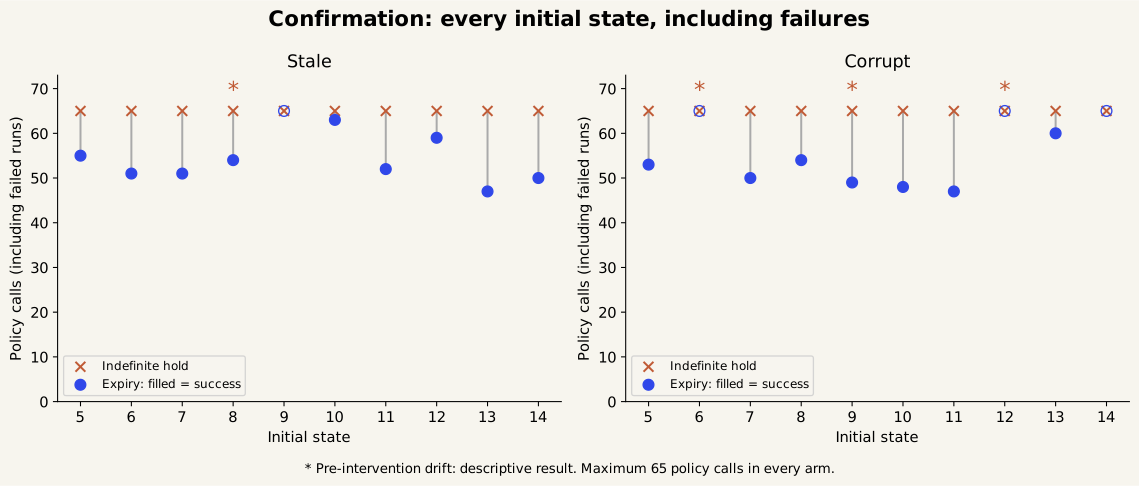
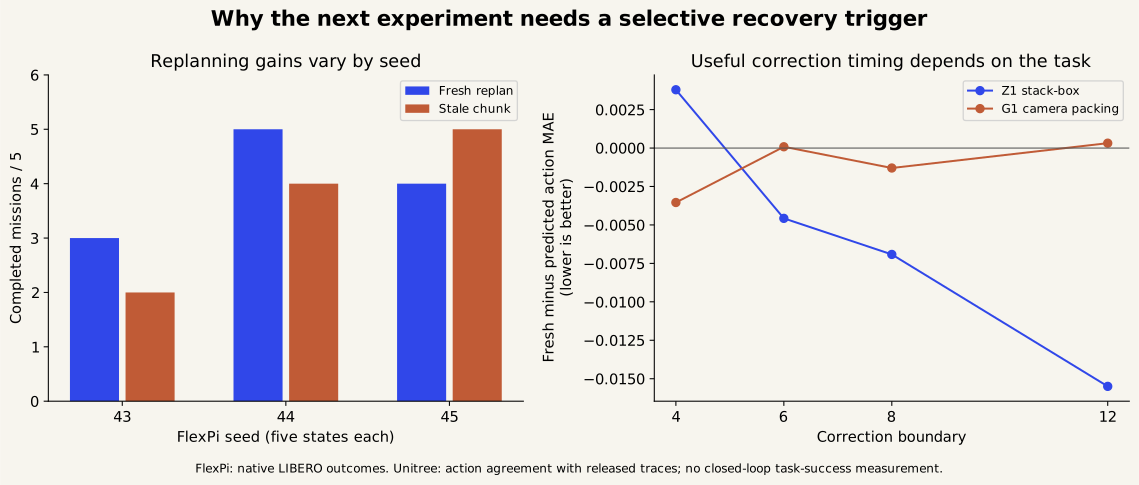
A multi-month program for studying typed interfaces between semantic planning, persistent memory, learned skills, motion execution, recovery, and control.

Reflect experiment diagram showing semantic decisions flowing through policy, runtime, and evaluation interfaces
Repository diagramTyped interface flow from a checked-in Reflect experiment
Planning + memory
Skill / policy
Motion + recovery
Bounded control
Inspect the research program

Problem

Robot stacks mix slow semantic decisions with fast control. The project asks what information belongs at each boundary and which failures should trigger refresh, retry, replan, or abort.

Built

A typed Python runtime, persistent state, replayable rollouts, source provenance, safety defaults, MuJoCo and pure-Python studies, reconstructable result packs, and more than 600 tests.

Tested

Controlled studies cover action chunks, recovery, storage triggers, appearance shifts, geometry-aware execution, world-model ranking, and two- versus three-layer routing.

Learned

Separating live belief from durable state and making recovery decisions explicit produced interfaces that were easier to reason about and test.

Still open

The current architecture is synthetic and simulator-backed. It is not a finished general robot system and does not claim physical-robot validation.

Inspect

Read the program, experiments, tests, and retained results on GitHub ↗

Policy execution

VLA Determinism

A repeated-inference harness for measuring what changes when ACT, VQ-BeT, and MolmoAct2 see the same observation more than once.

Fixed observation
100 repeated calls
Drift + latency
Inspect the experiment

Problem

Sampling, latent codes, flow noise, normalization, and replanning cadence can change the commands a robot receives even when the input is fixed.

Built

Shared adapters, deterministic and stochastic modes, LIBERO snapshot extraction, benchmark output, latency and deadline metrics, and lightweight stand-ins.

Tested

The local suite checks metrics, adapters, token logging, snapshot format, and artifact generation without requiring large checkpoints.

Learned

A policy needs an execution contract around it; model weights alone do not define repeatable robot behavior.

Still open

The full comparison still needs the LIBERO dataset, 50 snapshots, third-party repositories, and real checkpoints. Stand-in tests are not checkpoint results.

Inspect

Inspect adapters, metrics, and benchmark runner ↗

Simulation operations

Unitree R1 Program

A safety-first simulation and cloud-operations program with explicit cost ceilings, ownership checks, cleanup, and retained run logs.

Bounded cloud job
Isaac Sim
Logs + cleanup
Inspect the infrastructure gate

Problem

Robot simulation in the cloud needs reproducible GPU setup, hard cost limits, safe resource ownership, and failure-aware cleanup before policy work begins.

Built

A staged campaign, loopback-only safety rules, and a Google Cloud watchdog that can delete only the exact VM and disk identified by name, ID, and run nonce.

Tested

Isaac Sim 6.0.1 started headlessly on an NVIDIA L4, initialized Vulkan and Warp, and completed the stock finite simulation loop.

Learned

The GPU/container path works, while shutdown behavior needs tighter handling: fast shutdown hit a busy task group and orderly shutdown exceeded its bound.

Still open

This validates simulator infrastructure, not Isaac Lab, an R1 environment, a trained policy, or physical deployment.

Inspect

Read the result report, watchdog, and retained logs ↗

§02 / Quantum

Quantum Systems and Scientific Computing

Work on temporal models for quantum devices, fault-tolerant architectures, error-correction experiments, and measurement-aware sensing.

Primary quantum flagship

Quantum Process-Tensor World Models

A model-comparison program using real superconducting-qubit data, process tensors, tensor networks, recurrent models, differentiable channels, and delay-aware inference.

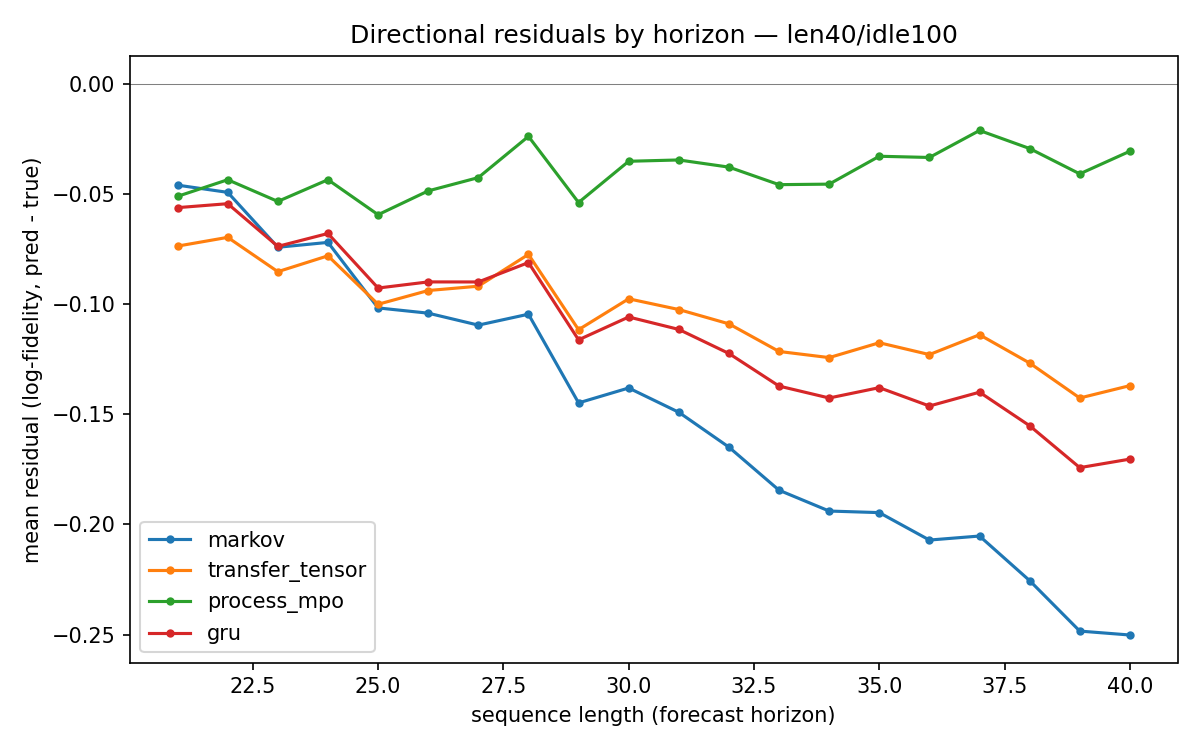
Measured residual error by sequence length for quantum forecasting models on idle-100 nanosecond device data
Measured resultResiduals by sequence length on a released superconducting-qubit condition
Controls + observations
Temporal model
Forecast
Matched controls

Bounded result: a 79-parameter process MPO improved both idle-100 long-horizon tests, with a largest log-MSE gain of 44%; stronger memoryless physics models explained part of that advantage.

Inspect the model comparison

Problem

Can a compact memory model predict how a real quantum device behaves after long intervention sequences, and does any gain survive strong physical baselines?

Built

A shared pipeline for Markov channels, transfer tensors, process MPOs, GRUs, Transformers, online learning, streaming artifacts, and process-matrix analysis.

Tested

Four device conditions with 109,200 randomized-benchmarking sequences per condition, leakage-safe splits, matched coherent/damping/CPTP controls, and physicality checks.

Learned

More memory was not automatically better. A fair matched-feature batch control reversed the initial online-learning conclusion, and process-matrix analysis reproduced the source negativity values.

Still open

Several neural comparisons need broader seeds; streaming tests are synthetic; sequence fidelity is compressed; and no stable policy-improvement result is claimed.

Inspect

Inspect results, plots, code, and research notes ↗

Interactive architecture simulator

Oratomic 10k

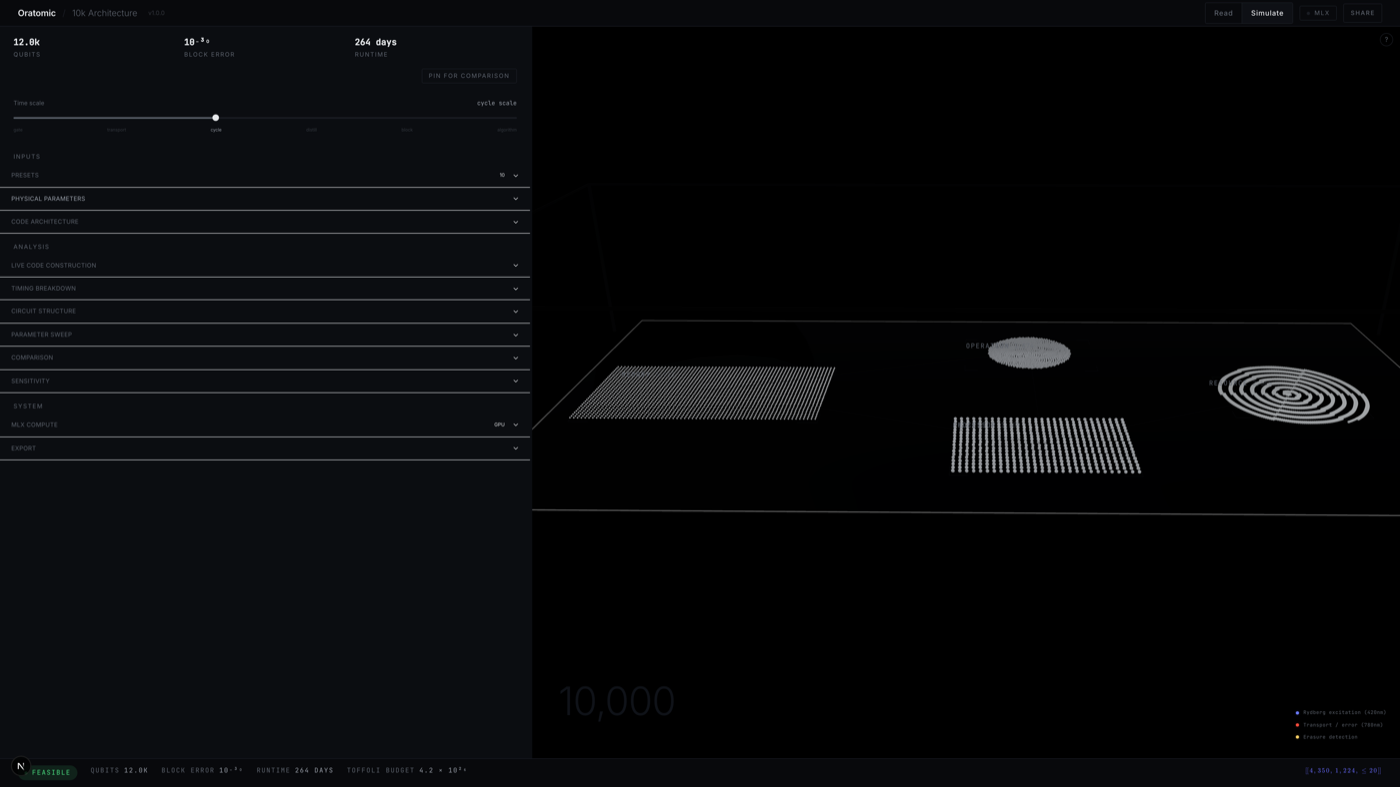
A browser-native 3D architecture simulator for fault-tolerant quantum computation with 10,000 reconfigurable atomic qubits.

Oratomic 10k live simulator showing a 3D atomic-qubit architecture and parameter controls
Live simulator capturePhysical error, code, cycle-time, runtime, feasibility, and qubit-allocation controls
Inspect the simulator

Problem

Fault-tolerant resource estimates are difficult to reason about when code choices, physical error, cycle time, runtime, and qubit allocation are separated across tables.

Built

A Next.js and Three.js viewer with four architecture zones, live Tanner graphs, sensitivity sweeps, comparison views, shareable state, and JSON/CSV export.

Tested

The browser simulator updates allocation, logical error, runtime, feasibility, and the 3D scene from the same controlled state.

Learned

An interactive model makes assumptions and tradeoffs easier to inspect than a fixed resource table.

Still open

This is an independent implementation of a published architecture proposal, not an affiliated hardware result.

Inspect

Use the live simulator ↗
Read the implementation ↗

Quantum error correction

qLDPC-FNO

A reproducible investigation of Fourier neural priors and causal noise forecasts for cyclic quantum-LDPC decoding with Stim and BP-LSD.

Syndrome
FNO prior
BP-LSD check

Stopped result: uniform BP-LSD had 387 block failures in 2,048 held-out shots; the learned soft-prior and proposal variants had 835 and 819.

Inspect the negative result

Problem

Can a Fourier prior exploit a cyclic code structure without breaking the algebraic constraints that make a correction valid?

Built

A fixed BP-LSD comparison, ring FNO priors, proposal-plus-residual repair, causal CNN/FNO × FIR/HiPPO screens, provenance, and restartable artifacts.

Tested

A fixed-shot held-out comparison at physical error rate 0.0375, with syndrome validity counted before imitation accuracy or timing.

Learned

High agreement with teacher correction bits can coexist with invalid syndromes and worse block-error rate.

Still open

A learned view is useful only if it adds correct logical classes to stronger decoder portfolios and a deployable selector can recognize them.

Inspect

Inspect methods, tests, and disconfirming results ↗

Quantum sensing benchmark

NV ODMR TrackBench

A matched-budget benchmark for causal tracking of resonance center, linewidth, and Q across eight resolved NV-center ODMR resonances.

Causal samples
Sparse / sweep fit
Matched budgets
Inspect the benchmark design

Problem

Tracking must be compared under the same measurement time, fluorescence samples, photon budget, and compute budget—not only by fit quality.

Built

Causal playback, a seeded eight-resonance virtual instrument, constrained full-sweep fits, two-point center tracking, and sparse-linewidth tracking.

Tested

Deterministic fixtures cover spectrum generation, fit diagnostics, warm starts, virtual time, resource ledgers, and asynchronous center/linewidth epochs.

Learned

A fast estimator is not meaningful unless acquisition and compute resources are counted together and resonance identity remains stable.

Still open

The matched-budget superiority experiment has not been completed; generated examples are software fixtures, not benchmark wins.

Inspect

Inspect the scientific spec, estimators, and virtual instrument ↗

§03 / Selected tools

More engineering work

Smaller systems and focused experiments across ML serving, scientific tooling, photonics, research software, and optimization.

ML infrastructure

adapter-cache-tradeoffs

Measures routing, cache locality, load, tail latency, and quality-adjusted goodput for specialist adapters; the canonical SGLang experiment remains pending.

Tensor networks

TNView

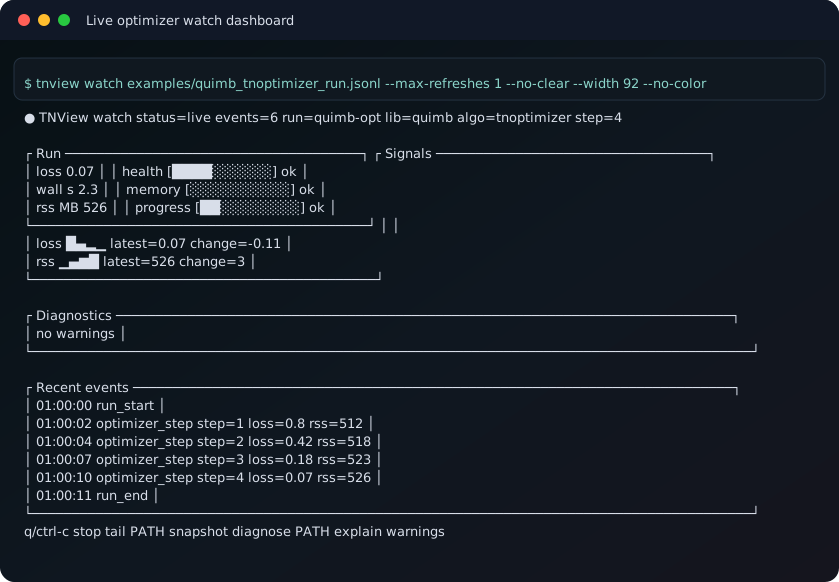
Append-only telemetry, replay, diagnosis, and comparison tools for long DMRG, TEBD, and tensor-network optimization runs.

Photonic control

pic-autotune-control

A virtual lab for bounded photonic-chip tuning under measurement budgets, drift, crosstalk, device variation, and faults.

Robot data

episode-lens

Converts and inspects robot demonstrations, scores deterministic quality signals, and prepares fixed-budget data-selection tests.

Research software

marginalia

A budget-aware paper-reading workspace that tracks searches, quotes, citations, saved papers, synthesis, and retrieval cost.

Policy search

policy-climb

A deterministic benchmark for comparing bounded policy-search strategies under the same evaluator-call budget.

Optical links

linkscope

A behavioral silicon-photonic link simulator with real Gray-coded bit-error counts, calibration, drift, and FFE adaptation.

Interpretability

linebreak-uncertainty

Tests whether small language models encode fixed-width line position; current readouts are diagnostic, not causal proof.

Optimization

memplex

Controlled Fisher-spectrum experiments for adapting natural-gradient damping as curvature quality changes.

Offline RL

qgf-autoresearch

A bounded Q-Guided Flow replication record that preserved failure modes and stopped scaling when the result was not defensible.

Generated TNView terminal dashboard showing tensor-network run telemetry
Generated terminal example from the TNView repository; interface demonstration, not classifier validation.
§04 / Background

Background

Physics training and systems work across quantum sensing, molecular dynamics, photonics, and hardware-software integration.

2025–2026

Dirac Labs

Founding Systems Engineer. Built sensor pipelines, Kalman filtering, and neural denoising for quantum magnetometry at 10–100 Hz real-time rates.

ETH Zurich

Theoretical molecular quantum dynamics

Thesis work accelerating nuclear-dynamics propagation using tensor-network methods.

EPFL

Quantum photonics

Thesis work simulating and fabricating diamond photonic integrated circuits for quantum sensing.

BITS Pilani

Engineering + physics

B.E. Manufacturing and M.Sc. Physics.

§05 / Contact

Let’s talk about hard systems.

For research engineering, robotics, quantum systems, scientific ML, or technical collaborations, email is the most direct route.

Oratomic 10k simulator

Inspect the QPU, physical control stack, noise pathways, runtime, and feasibility under live assumptions.